
In conventional lithium–sulfur (Li||S) and lithium–selenium (Li||Se) batteries, chalcogen cathodes (S and Se) operate through a two-electron redox reaction from the elemental state (0) to the −2 state. Although these chemistries offer high theoretical specific capacities and low material costs, their practical applications remain constrained by relatively low operating voltages (~2.0 V), sluggish redox kinetics, and the polysulfide/polyselenide shuttle effect.
传统锂硫(Li||S)和锂硒(Li||Se)电池中,硫族正极(S和Se)基于从0价到-2价的两电子反应。虽然具有高理论比容量和低成本优势,但其实际应用受限于低工作电压(~2.0 V)、缓慢的氧化还原动力学以及多硫/硒化物穿梭效应。
In principle, sulfur and selenium can be further oxidized to higher oxidation states, such as +1, +2, and even +6, offering opportunities for multi-electron energy storage beyond the conventional two-electron reaction. However, reversible high-valent S and Se chemistry has long remained challenging to realize in lithium batteries. Activating and stabilizing high-valent chalcogen redox chemistry therefore represents a key scientific challenge in overcoming the energy-density limitations of batteries.
理论上,硫和硒在充电过程中可被进一步氧化至更高价态,如 +1、+2、甚至 +6,从而实现超越传统两电子反应的多电子储能,但锂电中可逆的高价S和Se化学长期以来难以实现。因此,如何实现高价态硫族元素氧化还原反应的激活与稳定,是突破电池能量密度瓶颈的关键科学问题。
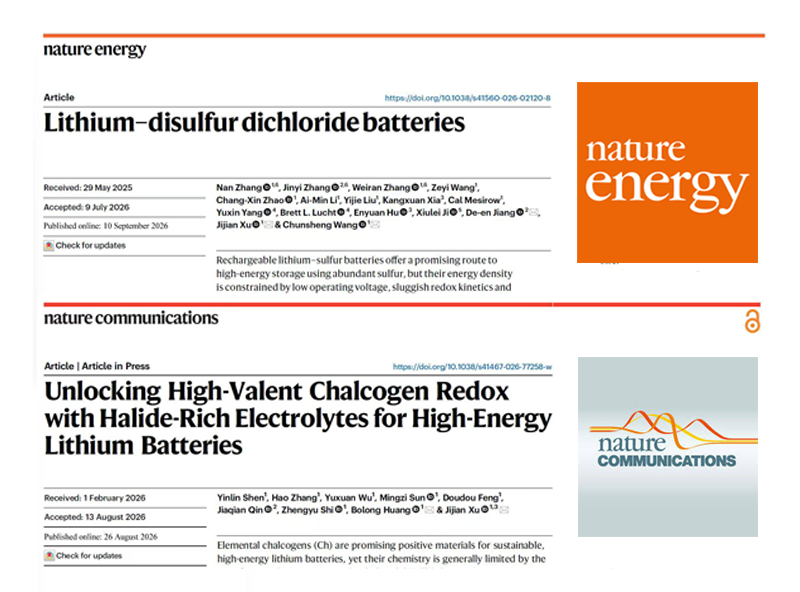
Recently, our group reported important advances in Nature Energy and Nature Communications, introducing a chloride-rich electrolyte design strategy that enables reversible high-valent redox chemistry of chalcogen cathodes in lithium batteries. This strategy extends the conventional two-electron reaction to a three-electron conversion process while simultaneously increasing the output voltage, thereby substantially enhancing battery energy density.
近日,课题组在 Nature Energy 和Nature Communications上发表系列重要研究成果,提出了富氯离子电解液设计策略,在锂电池中实现了硫族正极的可逆高价氧化还原,将传统两电子反应拓展为三电子转化反应并提升输出电压,显著提升了电池的能量密度。
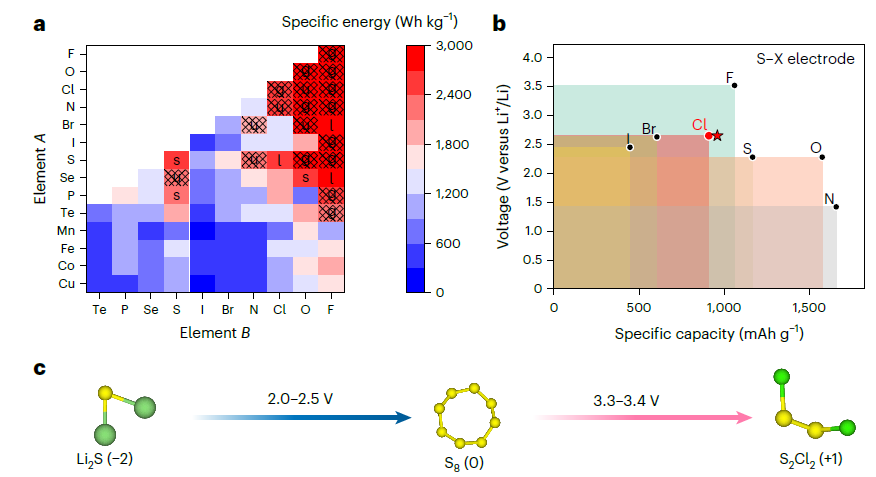
In the Nature Energy study, S and LiCl were employed as the initial cathode materials to realize a reversible S(2−)/S(0)/S(1+) three-electron redox process. Compared with conventional lithium–sulfur batteries, the system increases the average operating voltage from 2.05 V to 2.54 V and delivers an electrode-level specific energy exceeding 1700 Wh/kg.
Nature Energy的工作以 S 和 LiCl 作为初始正极材料,实现可逆的 S(2−)/S(0)/S(1+) 三电子氧化还原过程。与传统锂硫电池相比,该体系将平均工作电压从2.05 V 提升至2.54 V,并实现超过 1700 Wh/kg 的电极级能量密度。
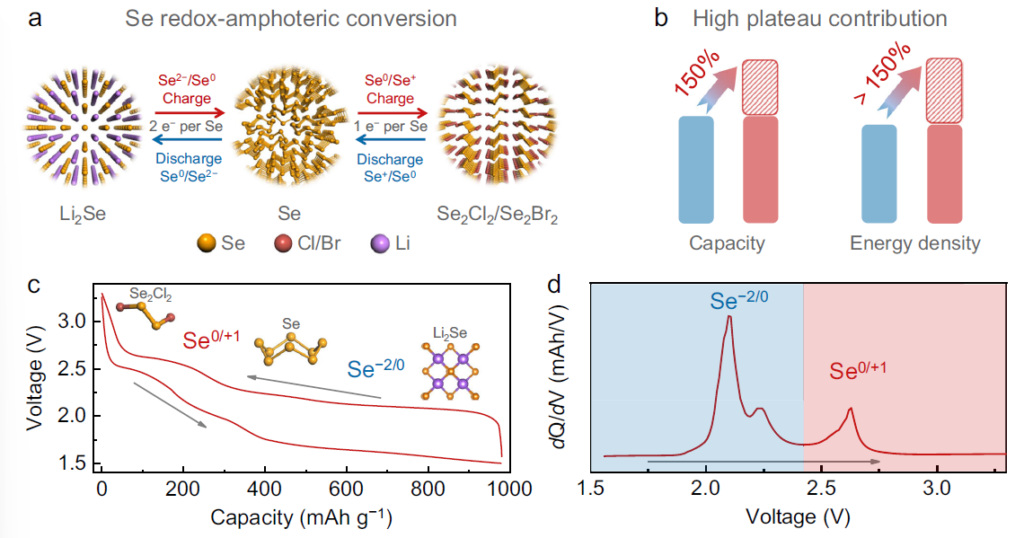
The Nature Communications study further extends the conventional Se(0)/Se(2−) two-electron chemistry of Li||Se batteries to a reversible Se(2−)/Se(0)/Se(1+) three-electron redox chemistry. The concept was further demonstrated across a broader range of chalcogen systems, including Se, S, and SeS2, highlighting the general applicability of this strategy.
Nature Communications的工作进一步将传统Li||Se体系中局限于Se(0)/Se(2−)的两电子反应拓展为可逆的Se(2−)/Se(0)/Se(1+)三电子转化反应,并将这一策略推广至 Se、S 和 SeS₂ 等硫族体系,进一步验证其普适性。
For those interested in learning more about the papers, please read the full papers here:
1. Nan Zhang, Jinyi Zhang, Weiran Zhang, Zeyi Wang, Chang-Xin Zhao, Ai-Min Li, Yijie Liu, Kangxuan Xia, Cal Mesirow, Yuxin Yang, Brett L. Lucht, Enyuan Hu, Xiulei Ji, De-en Jiang*, Jijian Xu*, Chunsheng Wang*. Lithium-disulfur dichloride batteries. Nature Energy (2026).
2. Yinlin Shen, Hao Zhang, Yuxuan Wu, Mingzi Sun, Doudou Feng, Jiaqian Qin, Zhengyu Shi, Bolong Huang*, Jijian Xu*. Unlocking High-Valent Chalcogen Redox with Halide-Rich Electrolytes for High-Energy Lithium Batteries. Nature Communications (2026).